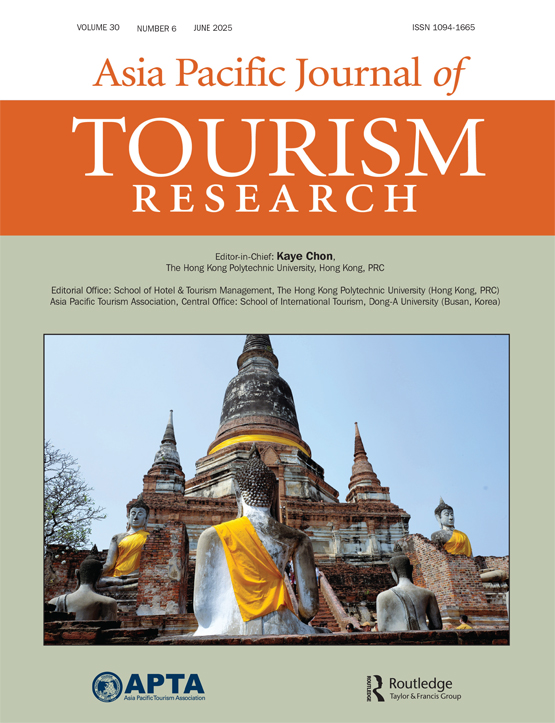
Published in: Asia Pacific Journal of Tourism Research
DOI: 10.1080/10941665.2025.2516589
Overview
How do tourism capital investment, green technology, and renewable energy interact with climate change across the fast-growing Asia-Pacific region? Our latest study uses the STIRPAT model and a robust panel data approach to assess the environmental consequences of key economic drivers—offering actionable insights for sustainable tourism development in an era of climate urgency.
Key Findings
- Tourism Capital Investment Reduces Emissions
Contrary to the assumption that tourism development is always environmentally harmful, results show that increased tourism investment is associated with lower CO₂ emissions, particularly when paired with technological upgrades. - Green Technology as a Critical Lever
Green technological innovation significantly reduces emissions, demonstrating that sustainable tourism growth is possible if supported by clean technologies. - Renewable Energy Consistently Helps
The role of renewable energy is unambiguous—it systematically lowers CO₂ emissions across all quantiles of analysis. - Foreign Direct Investment (FDI) Has Trade-Offs
FDI, especially in industrial sectors, contributes to increased emissions, suggesting the need for regulatory safeguards on incoming investments. - Population and Economic Growth Pose Challenges
As expected, rising population and affluence levels continue to exacerbate climate pressures in the region, reinforcing the urgency of mitigation strategies.
Why This Matters
This study directly addresses a core tension in sustainable development: how to balance tourism-led economic growth with environmental responsibility. The Asia-Pacific region—home to booming tourism economies and climate-vulnerable populations—faces critical decisions.
Our evidence supports a “green investment pathway” for tourism, where smart capital allocation, clean technology, and renewable energy can work in synergy to reduce carbon footprints.
Practical Implications
- Promote Green Tourism Infrastructure
Policymakers should prioritize low-emission, energy-efficient tourism investments, particularly in transport, accommodation, and destination infrastructure. - Incentivize Green Technology Transfer
Investment incentives should be tied to technology-based emissions reductions, especially in tourism services and facilities. - Regulate FDI for Environmental Impact
While FDI boosts economic growth, it must be regulated to ensure compliance with national climate goals and clean energy transitions. - Tailor Policies by Development Stage
The quantile regression results show variation across countries—one-size-fits-all policies won’t work. Strategies must be adapted to each country’s emission profile and growth stage.
Keywords
Tourism capital investment; green technological innovation; renewable energy; foreign direct investment; climate change; STIRPAT model; Asia-Pacific.
How to Cite This Research
Farah Sadiq, Ante Mandić & Tafazal Kumail (2025). Tourism capital investment and climate dynamics: insights from the Asia-Pacific region. Asia Pacific Journal of Tourism Research.
https://doi.org/10.1080/10941665.2025.2516589
Read the Full Study
Access the full article here: Asia Pacific Journal of Tourism Research
 antemandic